
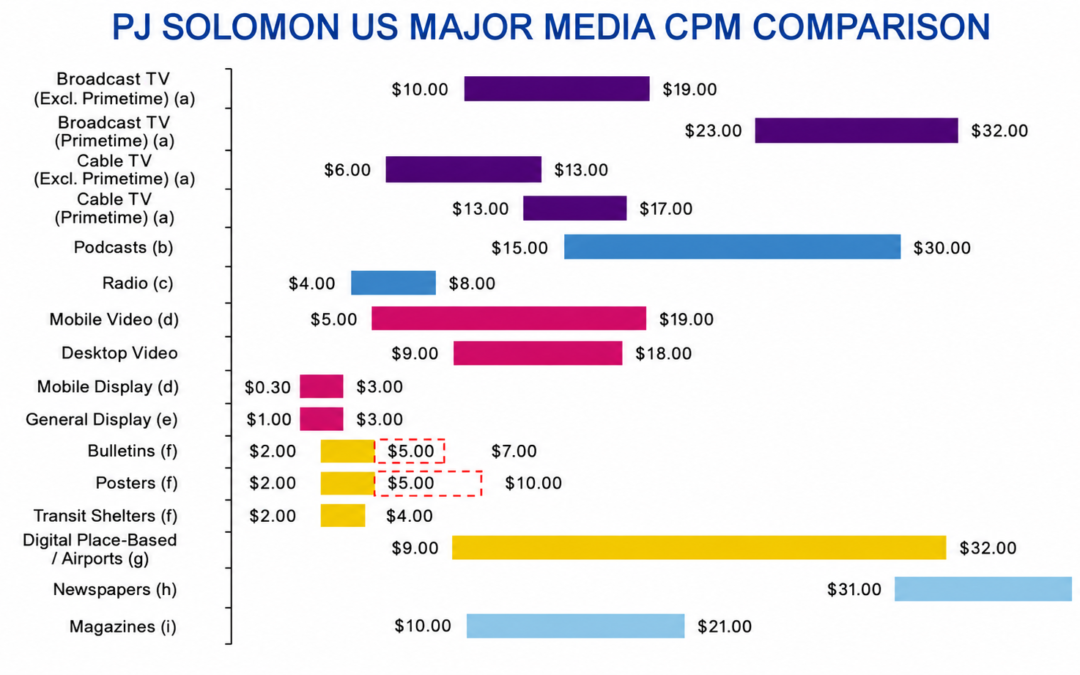
Comparing billboard CPM to other media outlets can be misleading. Learn how to evaluate CPM, impressions, and real-world impact to choose the right mix.
It’s tempting to compare billboard CPMs to digital ads and make a quick decision. But CPM comparisons can mislead if you don’t account for what billboards actually do best: high-impact, repeated exposure in the real world.
What CPM means in billboard advertising
CPM is “cost per thousand” impressions. It’s a way to estimate how efficiently you’re buying exposure.
Why billboard CPMs can look “too good” or “too confusing”
Because:
- Impressions are modeled estimates
- Visibility and read time vary by placement
- Not all impressions are equally valuable
A better way to compare billboards to other media
Instead of asking “which CPM is lower?” ask:
- Which channel builds recognition fastest in my market?
- Which channel reaches people when they’re physically near my locations?
- Which channel supports my other marketing (search, social, radio, etc.)?
Where billboards often win
Billboards can outperform on:
- Local market dominance
- Multi-location awareness
- Repetition on commuter routes
- Credibility (“they must be established”)
Where billboards need the right plan
Billboards are less forgiving when:
- Creative is too complex
- Placement is chosen without corridor logic
- Flight/exposure length is too short
Want help building a plan that makes CPM comparisons irrelevant?
When placements and creative are right, the question shifts from “what’s the CPM?” to “how fast can we own this market?” Request a plan today.